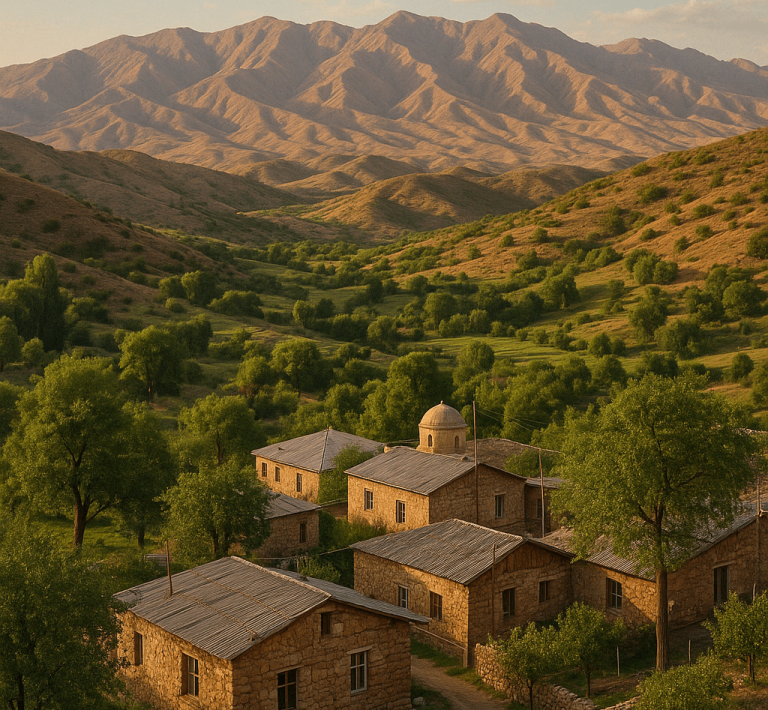
This is a route for people who plan trips with their stomach. Central Asia food rewards slow wanderers who follow spice aromas, the bakery queue, or the glow of a tandoor. Between Ashgabat and Tashkent, you can snack through markets, sip local wine in Samarkand, and catch a Khivan sunset with a plate of something green and dill-scented. The meals are simple, honest and often cooked in sight of the table. Expect more bread than you thought possible, a lot of skewers, and one venue working with five cast‑iron cauldrons. Here are nine flavorful stops and exactly how to try them without wasting time or appetite.
1. A carpet‑patterned market where lunch finds you
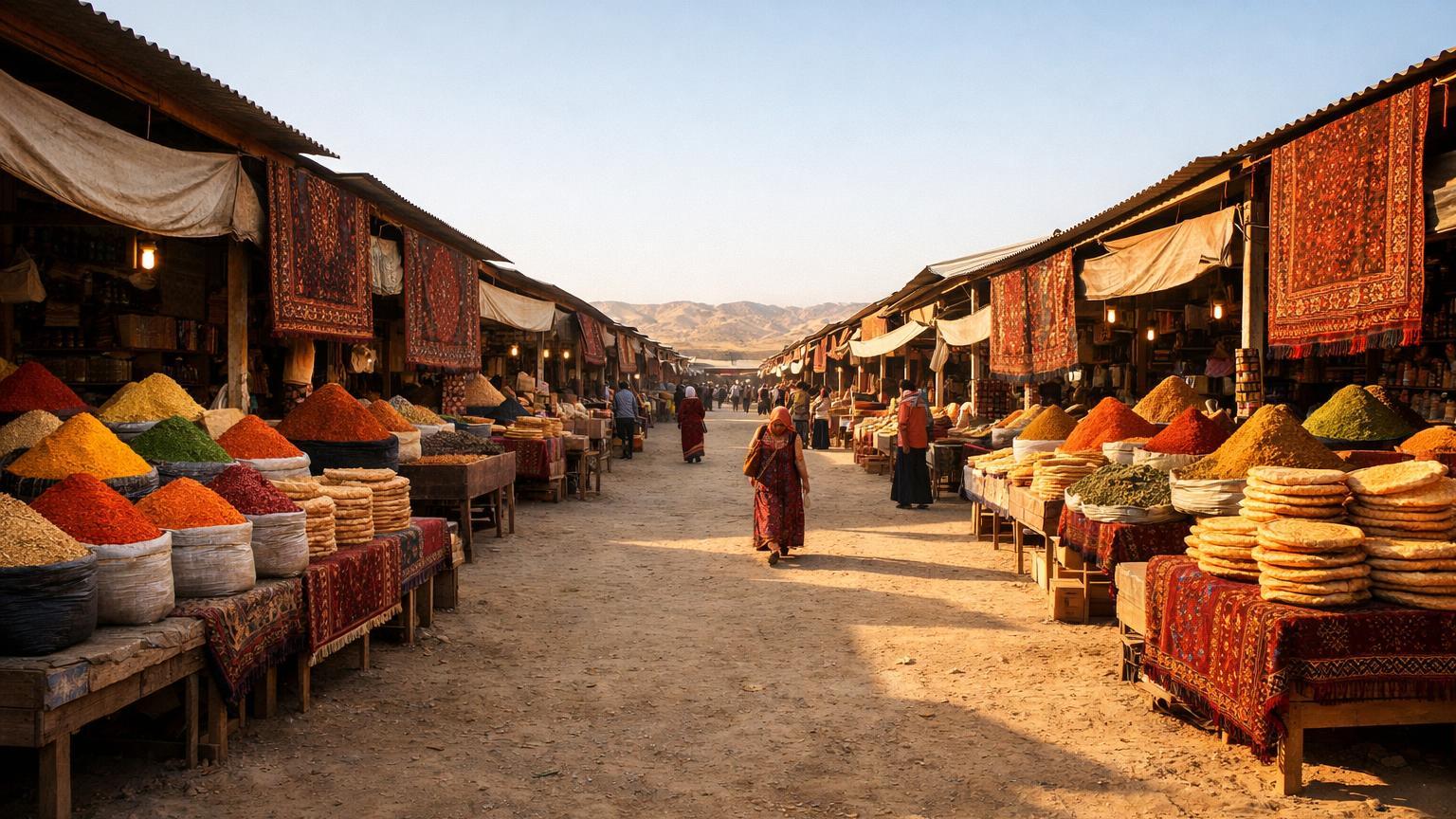
North of Ashgabat, a colossal market is laid out like a Turkmen carpet medallion, with aisles forming a stylized gül and sections for carpets, spices, dried fruit and livestock on busy weekends[1]. Locals still call it Tolkuchka; the market’s newer Altyn Asyr complex is the country’s largest and one of Central Asia’s big bazaars[2].
You don’t come here with a reservation. Food finds you: shashlik smoke from a corner grill, pilaf ladled from a kazan, flatbreads stacked shoulder‑high, and seasonal fruit you can eat as you walk. Weekend mornings are the fullest, so aim early if you want to see the livestock pens and still find shade between runs of rugs[1].
Good to know: Getting there: Take a taxi north of the city toward Choganly; drivers know “Tolkuchka” by name[1]. Best time: Saturday or Sunday morning, when the market is at its liveliest[1]. Cost: Entry is free; bring small manat notes for snacks and bargaining[1]. Tip: Photograph patterns, not people—ask first, and mind carpet‑export paperwork if you buy a vintage piece[2].
2. Khiva’s green noodles, with sunset from a roof terrace
Khiva has a dish that looks like spring on a plate: shivit oshi, noodles tinted green with dill, topped with a meat‑and‑vegetable stew and often served with tangy sour milk on the side[3]. It’s homely and satisfying, and yes, it tastes less herby than it looks.
The photogenic way to try it is on a rooftop inside the mud‑brick walls of Itchan Kala as the Kalta Minor turns teal at sunset; long‑running terraces such as Terrassa are known for those views and Khorezm specialties on the menu[4]. Expect mains to start around the mid‑single digits in US dollars and a full dinner to land roughly in the 7–15 USD bracket as of 2026, higher on the prime terraces[5].
Good to know: Getting there: Stay inside Itchan Kala or walk in via the western gates; rooftop terraces are signed, and Terrassa is an easy landmark[4]. Best time: Golden hour into sunset for the skyline over domes[4]. Cost: A plate of shivit oshi or another main runs around 7–15 USD as of 2026[5]. Tip: If the terrace is full, ask for a spot one level down; the light is softer and the breeze better[4].
3. Poolside chaikhana classics under mulberries
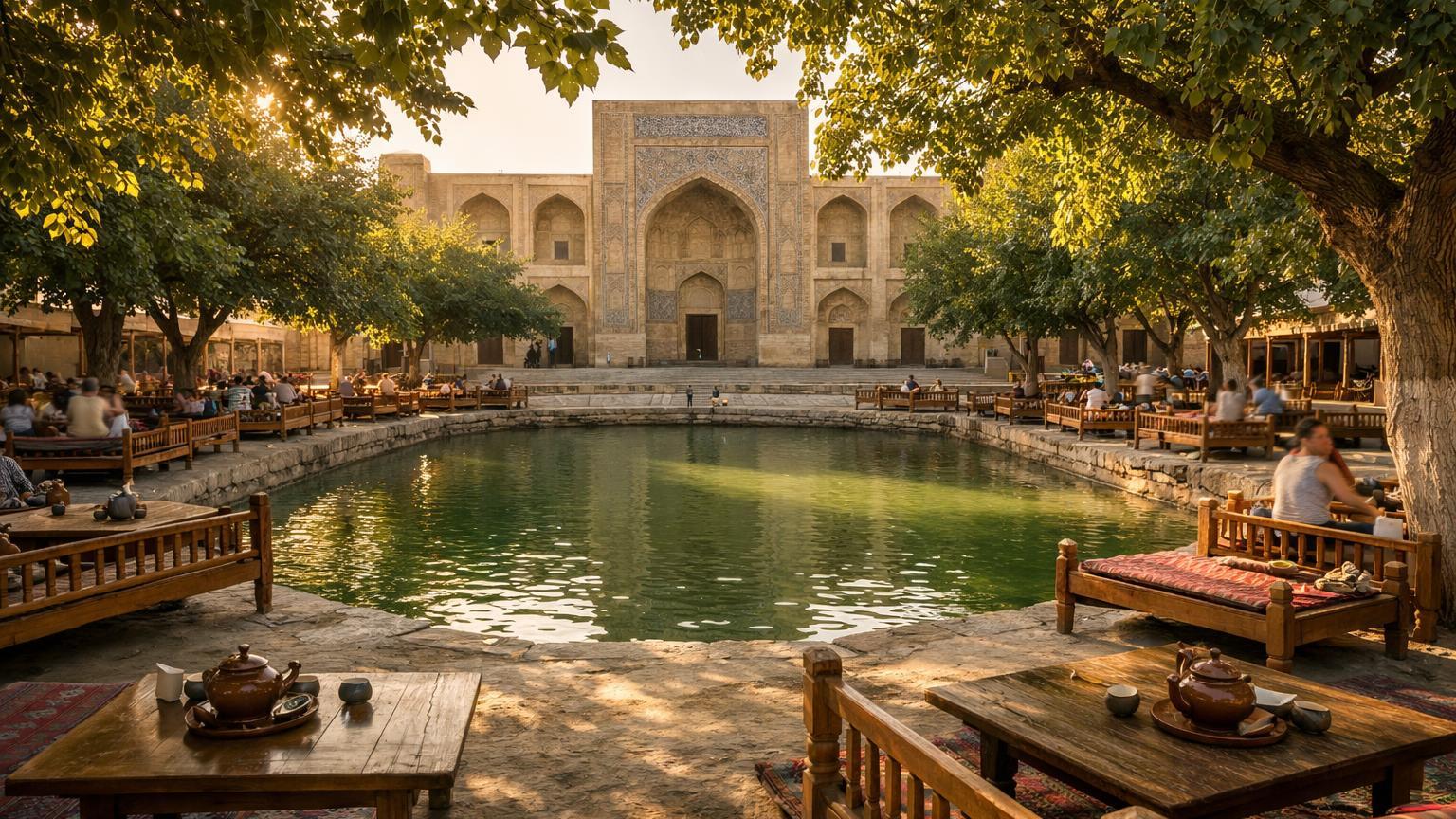
Bukhara’s Lyabi‑Hauz is a 17th‑century pool flanked by the Kukeldash Madrasah and two Nadir Divan‑Beghi buildings; it remains the city’s social heart, complete with teahouse benches under old mulberry trees[6]. Sit by the water and order what the chaikhana cooks best: kebabs, shurpa, salads and the local plov, with the splash of the fountain cutting the heat[7].
Several restaurants ring the pool. One of the longest‑running operations here opens daily from early morning to late evening, with an average check in the 70,000–150,000 UZS range as of October 2026, useful if you’re budgeting a long, lazy stop[7]. Prefer a midday ritual? A nearby historic terrace serves a fixed‑price Bukhara plov at lunchtime only, so plan around the window[8].
Good to know: Getting there: The square is central; most old‑town sights are within a 10–15 minute walk[6]. Best time: Late afternoon into evening when the madrasahs light up[6]. Cost: Poolside restaurants report average per‑person bills around 70,000–150,000 UZS; a set lunch plov nearby is about 55,000 UZS as of 2026[7][8]. Tip: Ask for a table right by the water; the fountain breeze is real air‑conditioning[7].
4. Smoke‑kissed kebabs on the Gijduvan stop
Road‑trippers swear by a detour to G’ijduvon, about 50–51 km north‑east of Bukhara, for the town’s beloved style of shashlik skewers, grilled so the fat melts and smokes the meat[9]. Several simple spots in town specialize in the local take; ask for G’ijduvon kebab and bread straight from the tandoor.
Prices in basic shashlik houses remain friendly: recent diners report a typical per‑person spend in the 150,000–200,000 UZS range when you include skewers, salad and bread[10]. Don’t have a car? A taxi run from Bukhara takes roughly 45 minutes and often quotes around 5–7 USD one way as of late‑2026, which is fair value for an edible pilgrimage[11].
Good to know: Getting there: Drive or take a taxi about an hour from Bukhara toward Samarkand; ask for G’ijduvon center[9][11]. Best time: Lunch, when grills are roaring. Cost: Plan around 150,000–200,000 UZS per person for a meal; budget 5–7 USD for a one‑way taxi from Bukhara[10][11]. Tip: Pair your stop with a peek at the town’s ceramics workshops between courses.
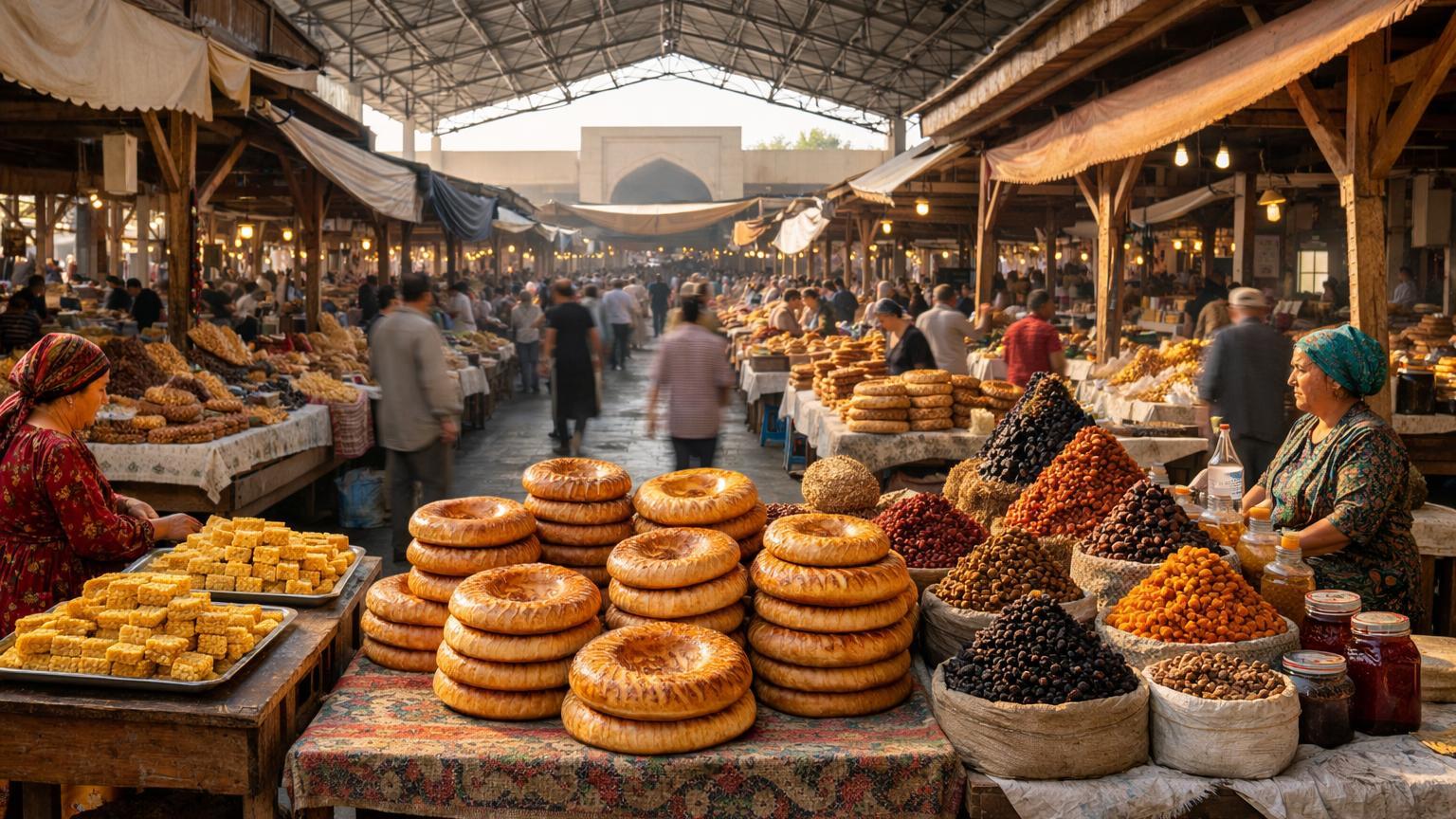
5. Bread, halva and fruit at Samarkand’s main market
The market behind Bibi‑Khanym is where Samarkand shops for the day: piles of dried apricots, walnuts and halva, and the famous non bread stacked in tall patterned towers[12][14]. Stalls are at their fullest early; a practical window runs from about 6 a.m. to early evening, and mornings make the best browsing[12].
Bakers here sell different sizes by weight, with everyday loaves in 2026 typically priced in a band of roughly 6,000 to 10,000 UZS depending on size and bakery, a small spend for a souvenir you can actually finish on the train[13]. If you prefer sweet, halva and parvarda are easy to sample before buying; most vendors are used to small tastings and cheerful haggling[14].
Good to know: Getting there: Walk five minutes north of Bibi‑Khanym Mosque; the bazaar sits just behind it[14]. Best time: Early morning for the bread rows and full produce selection[12]. Cost: Expect non bread around 6,000–10,000 UZS depending on size as of 2026[13]. Tip: Tap a loaf’s stamped center; a crisp sound means it’s fresh enough to ride in your daypack without going chewy by afternoon.
6. A century‑and‑a‑half of winemaking in an hour
Samarkand’s winemaking story starts in 1868, when entrepreneur Dmitry Filatov founded Turkestan’s first European‑style winery; the museum today sits in his late‑19th‑century house, and tastings pour a quick education in local styles[15]. The winery later took the name of Professor Mikhail Khovrenko, who arrived in 1927 and systematized production, varieties and blends across Uzbekistan[15].
Prices vary with the flight: the museum has posted a public rate of around 50,000 UZS for foreigners in 2025, while recent visitors report curated 10‑drink tastings closer to 200,000 UZS, so confirm on the day and pick the pour that suits your hour and palate[16][17]. The tasting complex is in central Samarkand on Kashgari (Mahmud Kashgari) Street; a taxi knows it, and the address is easy to map[18].
Good to know: Getting there: Short taxi from Registan or Bibi‑Khanym areas; give the driver the tasting complex and street name[18]. Best time: Late afternoon before dinner. Cost: Budget from around 50,000 UZS for a basic visit to roughly 200,000 UZS for larger flights, as reported in 2025–2026[16][17]. Tip: Eat a small snack first; flights can include dry and fortified styles in quick succession.
7. The heavyweight pastry that made a town famous
Ask someone in Uzbekistan about somsa and you’ll soon hear about Jizzakh. The region’s namesake pastry is generously sized, baked in a tandoor and packed with chopped meat and fat that turn meltingly soft as the dough blisters[19]. In Jizzakh city, Bogdon Street and nearby blocks host somsa houses where trays emerge from the oven and disappear even faster[20].
Prices swing with size and filling. As a handy reference, typical city‑counter somsas in 2026 run roughly 15,000–30,000 UZS in Tashkent; Jizzakh’s famous versions can be larger, so carry extra small notes and order to appetite[21]. One is often enough unless you are very, very hungry; sharing earns you local smiles and an extra pour of tea.
Good to know: Getting there: Jizzakh is on the main road and rail corridor between Samarkand and Tashkent; in town, ask for Bogdon ko‘chasi somsa rows[20]. Best time: Late morning or early lunch when the tandoor is in full swing. Cost: Plan around 15,000–30,000 UZS per piece as a reference; larger Jizzakh versions may cost more[21]. Tip: If taking away, ask for paper, not plastic, so the crust stays crisp[19].
8. Five cauldrons of plov beside the TV tower
Near the Tashkent TV Tower, a purpose‑built hall turns out industrial‑scale plates of plov from multiple giant kazans; this is the city’s most famous venue for the national dish and the flagship of the Beshqozon group[22]. It sits a short walk from the tower and is geared to speed: order at the counter, watch the rice shimmer with lamb fat and carrots, and find a table while your plate lands.
A typical plate cost sits around 50,000–59,000 UZS as of September 2026, depending on cut and add‑ons[23]. Timing matters; portions often sell out early afternoon, and lunch is the sweet spot to see all the cauldrons working[24]. It is busy, loud and entirely worth it; the fun is watching the choreography as much as eating.
Good to know: Getting there: Head to Iftixor Street near the TV Tower; Besh Qozon is about 230 m from the landmark[22]. Best time: Late morning to early afternoon; go before 14:00 for full choice[24]. Cost: Around 50,000–59,000 UZS per plate as of 2026[23]. Tip: Ask which kazan is serving Tashkent‑style plov that day if you like raisins and quail eggs; staff will point you to the right line[24].
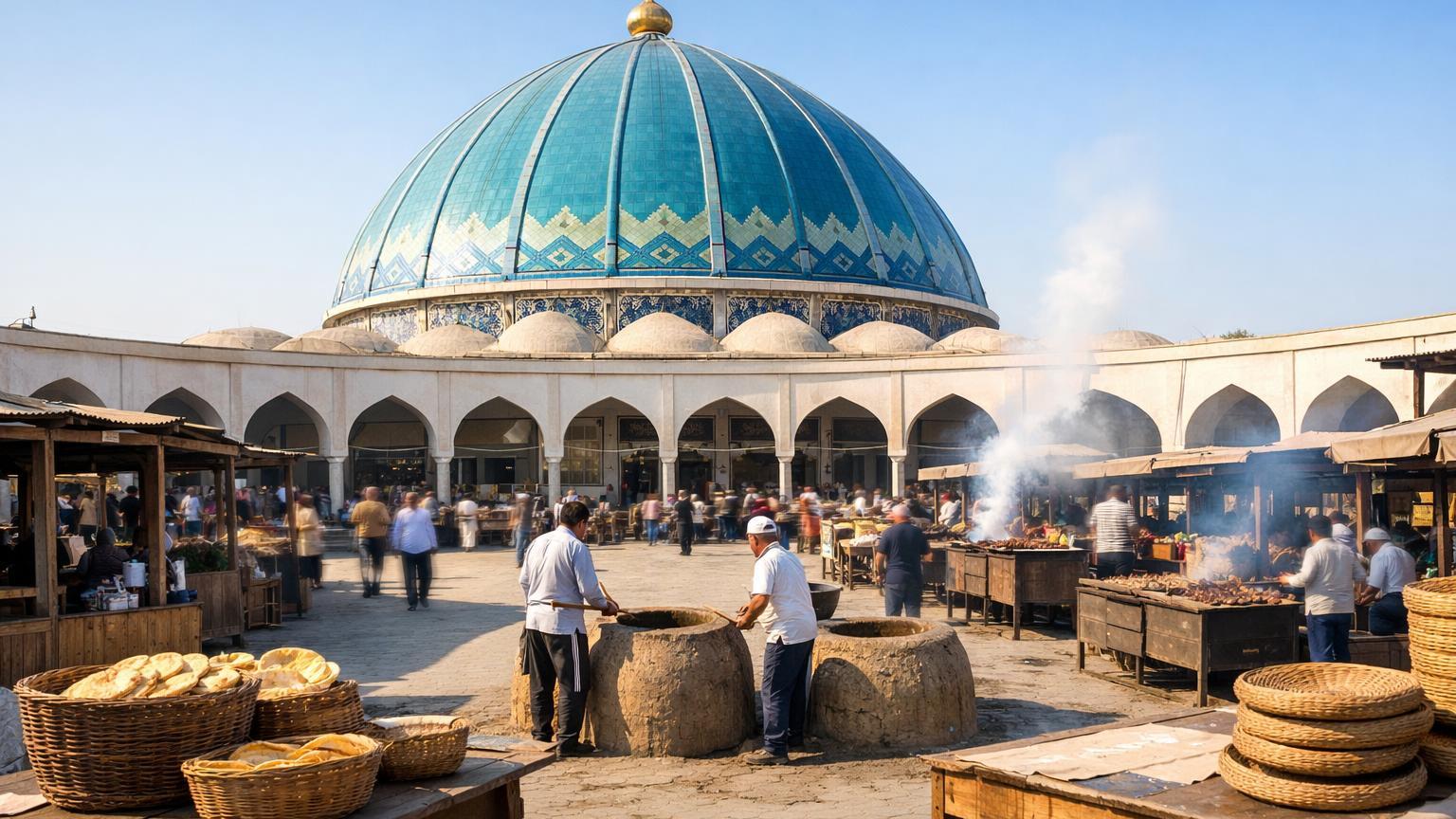
9. Tandoor row and snack‑hopping under the turquoise dome
Chorsu is Tashkent’s archetypal bazaar, a sea‑green domed hall with satellite canopies and a sprawl of outdoor rows for bread, grilled snacks and produce; the ensemble joined UNESCO’s World Heritage list of modernist sites in July 2026[25]. The east side’s bakeries turn out flats and samsa from morning, while the food court and plov stands nearby make it a one‑stop street‑food safari if you’re short on time[26].
For tiny purchases, prices are easy math. Expect a simple tandoor bread to cost on the order of 5,000–8,000 UZS in Tashkent as of 2025–2026, with vendor and size the main variables; buy one warm and tear into it before it cools[26]. Snack‑hop: a samsa, a skewer or two, a cup of tea, then back into the lanes for dried fruit to pocket for the train.
Good to know: Getting there: Take the metro to Chorsu and follow the flow up to the blue dome[25]. Best time: Mornings for hot bread and fast turnover in the snack rows[26]. Cost: Budget 5,000–8,000 UZS for a tandoor loaf; keep small notes for samsa and kebab stalls as of 2026[26]. Tip: Photograph the dome from the pedestrian bridge, then angle down to the bakery row for the best steam‑and‑sun shots[25].
Final thoughts
There’s a quiet theme to this trail: fires you can see and flavors you can name. It’s Central Asia food at its most direct, from a dill‑green noodle to rice scooped from a cast‑iron kazan. Pick two or three of these stops per day, eat early, and carry small notes. Your best souvenir might be a stamped loaf you’ll finish before the next station.
Sources
- Altyn Asyr Oriental Bazaar – what to expect (updated Sept 2026) ↩
- Altyn Asyr Bazaar – Wikipedia ↩
- Khorezm food: what to eat in Khiva (2026) – UzGidAI ↩
- Where to Eat in Khiva: 6 Restaurants for Khorezmian Food and Views – UZORA Travel ↩
- Where to Eat in Khiva: Inside the Walls vs Outside – Uzbekistan Wanderer (2026) ↩
- Lab‑i Hauz – Wikipedia ↩
- Labi Hovuz — Bukhara city — All Uzbekistan (hours, average bill) ↩
- Things to Do in Bukhara (Ayvan Restaurant lunch plov price) – Viaja con Gus (accessed Aug 2026) ↩
- Bukhara — Gijduvan distance/time — All Uzbekistan (2026) ↩
- Shashlik House, Gijduvon — Restaurant menu, reviews, price per person — RestaurantGuru ↩
- Bukhara to G’ijduvon travel time and taxi estimate — Rome2Rio ↩
- Siab Bazaar, Samarkand — practical info and hours — Samarqand.com (2026) ↩
- UzNews.uz — Samarkand non sizes and prices (report, Oct 2026) ↩
- Siyob Bazaar — Visit Uzbekistan (location, what to buy) ↩
- Khovrenko Winery & Museum (history) — sam.uz (EN) ↩
- Винзавод им. Ховренко (цены музея и дегустации) — sam.uz (RU) ↩
- Yandex Maps reviews — Khovrenko tasting price reports (200,000 UZS for 10 drinks, 2025) ↩
- TASTING COMPLEX OF THE SAMARKAND WINERY NAMED AFTER M.A. KHOVRENKO — Golden Pages (address; hours) ↩
- 10 reasons to visit Jizzakh region — Uzbekistan.travel (official) ↩
- Qipchoq Somsa — Jizzakh — All Uzbekistan (location info, Oct 2026) ↩
- Jizzax somsasi retsepti (reference prices, Oct 2026) — NimaOvqat ↩
- Beshqozon (Central Asian Plov Centre) — All Uzbekistan (near TV Tower) ↩
- Where to Eat in Tashkent (prices checked 2026): Besh Qozon plate 50–59k UZS — Uzbekistan Wanderer ↩
- Chorsu plov tasting and timing — Uzbekistan Guided Tours (go before noon; kazans) ↩
- Chorsu Bazaar — Wikipedia (modernist site; UNESCO inscription July 2026) ↩
- Reddit r/Uzbekistan — bread price discussion (5–8k UZS typical; 2025–2026) ↩